
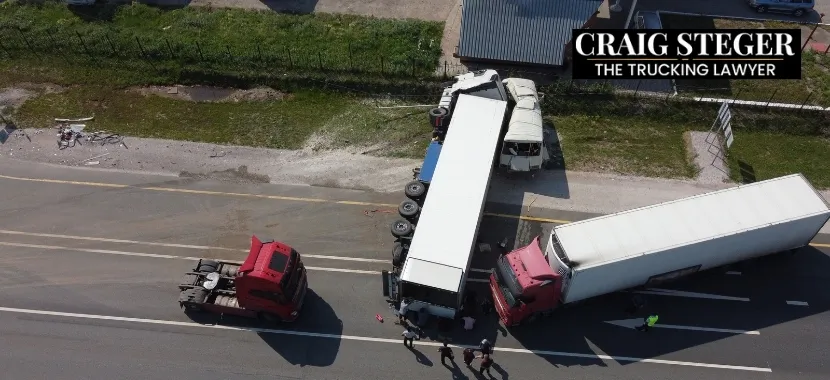
Determining what happened in the hours and days before a truck accident often involves reviewing a commercial driver’s schedule. Federal law restricts how long many commercial drivers can operate a truck and prescribes rest periods for drivers. Hours-of-Service violations in truck accident evidence in Wisconsin could become important evidence about how the crash happened and who is liable for damages.
Hours-of-service violations are just one issue that may arise after a commercial truck crash in western Wisconsin. Victims have needed support after truck accidents along I-90, US-53, US-14, and other rural highways connecting La Crosse with Onalaska, Holmen, West Salem, Sparta, and nearby farming communities.
Why Choose Craig Steger for Your Truck Accident Case?
Craig Steger has worked with injured motorists, truck drivers, farmers, and families for over two decades. Licensed in Wisconsin, Minnesota, and Iowa, Craig knows how to handle serious personal injury and wrongful death claims involving commercial trucks, farm equipment, and heavy machinery.
Craig also holds a Class A CDL with air brake and manual transmission endorsements, providing practical knowledge of trucking operations and commercial driving regulations.
Federal Hours-of-Service Limits
Federal truck accident laws govern driving time and duty status for many interstate commercial drivers. Rules vary depending on the type of commercial operation involved. Property-carrying drivers are typically subject to the following limits:
- Up to 11 hours of driving after 10 consecutive hours off duty
- No driving beyond the 14th consecutive hour after coming on duty
- A 30-minute break after eight cumulative hours of driving without a qualifying break
- Driving limited to 60 hours in seven consecutive days or 70 hours in eight consecutive days
Drivers may restart the seven- or eight-day time period after taking at least 34 consecutive hours off duty.
Commercial Truck Crashes in Wisconsin
Every year, thousands of crashes occur in Wisconsin involving large trucks and other commercial vehicles. The Wisconsin Department of Transportation publishes annual traffic crash facts that report these statistics. For instance, the agency’s 2024 Wisconsin Traffic Crash Facts indicates commercial motor vehicles were involved in 6,825 crashes in 2024. Commercial vehicle crashes resulted in 1,480 injuries and 66 deaths that year.
WisDOT’s crash facts reports show that CMV accidents occur on interstate, state, county, and local roads. Commercial drivers frequently travel through La Crosse on I-90 and other roads leading to or from smaller communities and agricultural areas.
Hours-of-service violations do not prove that commercial drivers caused every accident due to fatigue. The key is to strategically leverage hours-of-service records in conjunction with other crash-related evidence.
Proving an Hours-of-Service Violation
Electronic logging devices (ELDs) track a driver’s time on duty electronically, making it easier to reconstruct a driver’s schedule before a crash. An ELD synchronizes with a commercial motor vehicle’s engine and automatically records certain data about driving time.
However, truck accident cases should not rely solely upon the electronic log. Other records can help show whether a driver reported activities consistent with what actually occurred before an accident. Investigators may use:
- GPS tracking
- Fuel purchases
- Toll records
- Inspection reports
- Cargo receipts
- Dispatch communications
- Payroll records
Cell phone information or business records may help prove when calls were made or received, providing additional timestamps that could correspond with driver activities. If one set of records claims a driver was off duty at a specific time, but fuel or toll receipts, GPS data, or dispatch records suggest otherwise, that discrepancy can be significant. In that case, the evidence could prove an hours-of-service violation occurred.
Hours-of-Service Violations and Liability
A violation of hours-of-service rules can help prove facts that support allegations of negligence. However, proving a regulatory violation occurred does not automatically prove the violation caused a crash.
The link between a driver’s actions and the crash remains an important issue. Evidence that a driver exceeded allowable driving time might support an argument that fatigue caused slow reaction times or failure to recognize traffic stopping ahead. Vehicle data and witness accounts are also significant pieces of evidence.
Hours-of-service violations can also lead to questions about a trucking company’s practices. Trucking companies cannot require or permit drivers to violate federal hours-of-service limits. Dispatch records might show whether management was aware that a driver was approaching driving time limits and continued to schedule or encourage additional driving.
Violations That Occurred Before the Crash
Much attention focuses on when and how a driver spent their time immediately before an accident. However, past compliance issues can provide context in some situations. For example, inspection reports or company records might show that the driver or trucking company failed to comply with hours-of-service regulations in the past.
The FMCSA publishes safety information about regulated carriers, including certain information about hours-of-service compliance. Previous violations are not necessarily proof that a carrier caused a later truck accident. However, they may be relevant depending on what violations occurred and how they relate to the current claim.
Records can become important when determining if a carrier knew about repeated violations and failed to take any action. Similar evidence may also be relevant when investigating a Farm Accident, an Injured Truck Driver claim, an Underride Accident, or a Car Accident.
Hours-of-Service Violations and Wisconsin Truck Accident Claims
Wisconsin follows a comparative negligence rule that can reduce an injured person’s ability to recover compensation based on their percentage of fault for the accident. Recovery also depends on whether the injured person’s negligence is greater than the negligence of the party from whom they seek compensation.
This makes the evidence especially crucial when different parties are at odds over who’s to blame for an accident. A truck insurance company may argue that another driver pulled out in front of the truck, stopped suddenly, or otherwise contributed to a collision.
In La Crosse, a legal claim concerning a commercial truck accident would generally be initiated in the Circuit Court for La Crosse County, located at 333 Vine Street, La Crosse, WI 54601-3296, provided the court possesses jurisdiction and venue is appropriate.
Hire a Truck Accident Lawyer to Assist With Your Case
Victims of serious accidents involving commercial trucks can hire a truck accident lawyer to preserve and review evidence that may relate to hours-of-service violations. Your Wisconsin truck accident attorney can review evidence and submit the appropriate paperwork for your case.
An attorney can use discovery to obtain records after filing a claim and compare logs to receipts, shipping records, and other documents showing where drivers claimed to be and when. Your lawyer can depose drivers and company representatives about their conduct and work with accident reconstruction professionals to recreate how a driver spent their time.
Large truck accident cases require a careful investigation of what happened before a crash occurs. Identifying a technical violation of the law does not end the analysis or automatically prove liability. Using evidence from a crash to prove what happened and how it led to someone’s injuries or death can be crucial to pursuing appropriate compensation. Craig Steger can help.
FAQs
What Are Common Violations Faced by Truck Drivers?
Trucking violations can include hours-of-service limit violations, false log books, speeding, unsafe lane changing, tailgating, poor vehicle maintenance, improperly secured cargo, and operating without proper qualifications or certificates.
Many trucking-related laws that apply when driving between Wisconsin and other states are regulated by Federal Motor Carrier Safety Administration rules. Traffic violations that occurred on Wisconsin roads may also be subject to state traffic laws.
How Long Does a Truck Accident Claim Take?
Every truck accident case in Wisconsin is different. Some cases can be resolved quickly if there is nothing in dispute and the parties can settle the claim. However, if multiple entities are liable, injuries are catastrophic, significant discovery or depositions are required, or professional testimony is necessary, the claim can take years.
Contested liability or inadequate settlement offers from insurers could lead your case through motions, discovery, depositions, and ultimately to trial.
How Long Do Accidents Stay on Your Record in Wisconsin?
The length of time an accident stays on your Wisconsin driving record can vary depending on your driving record type and the circumstances surrounding the accident or conviction. However, it is common for most accident and conviction information to stay on your driving record for years from the date of the accident or date of conviction.
What Is the Statute of Limitations for Negligence in Wisconsin?
Wisconsin law generally allows three years to file a negligence claim that causes personal injury. Other types of claims may have different deadlines. The parties involved in the claim, particularly the defendant, can affect the applicable deadline.
For instance, if your claim involves negligence by a government agency, you may have a much shorter time to notify the government about your claim. It’s important to evaluate your potential claim early to determine what deadline applies.
Schedule Your Consultation Today
Hours-of-service violations can offer key evidence in the aftermath of a serious commercial truck accident. Establishing a driver’s hours-of-service violation often hinges on records that accident victims can’t obtain on their own. Craig Steger is familiar with federal trucking laws and the challenges of commercial trucking.
He knows how to preserve electronic logging information, obtain company and dispatching records, conduct an investigation into possible safety violations, and identify responsible parties.
Contact Craig today if you or a loved one was seriously injured or killed in a commercial truck accident.

